
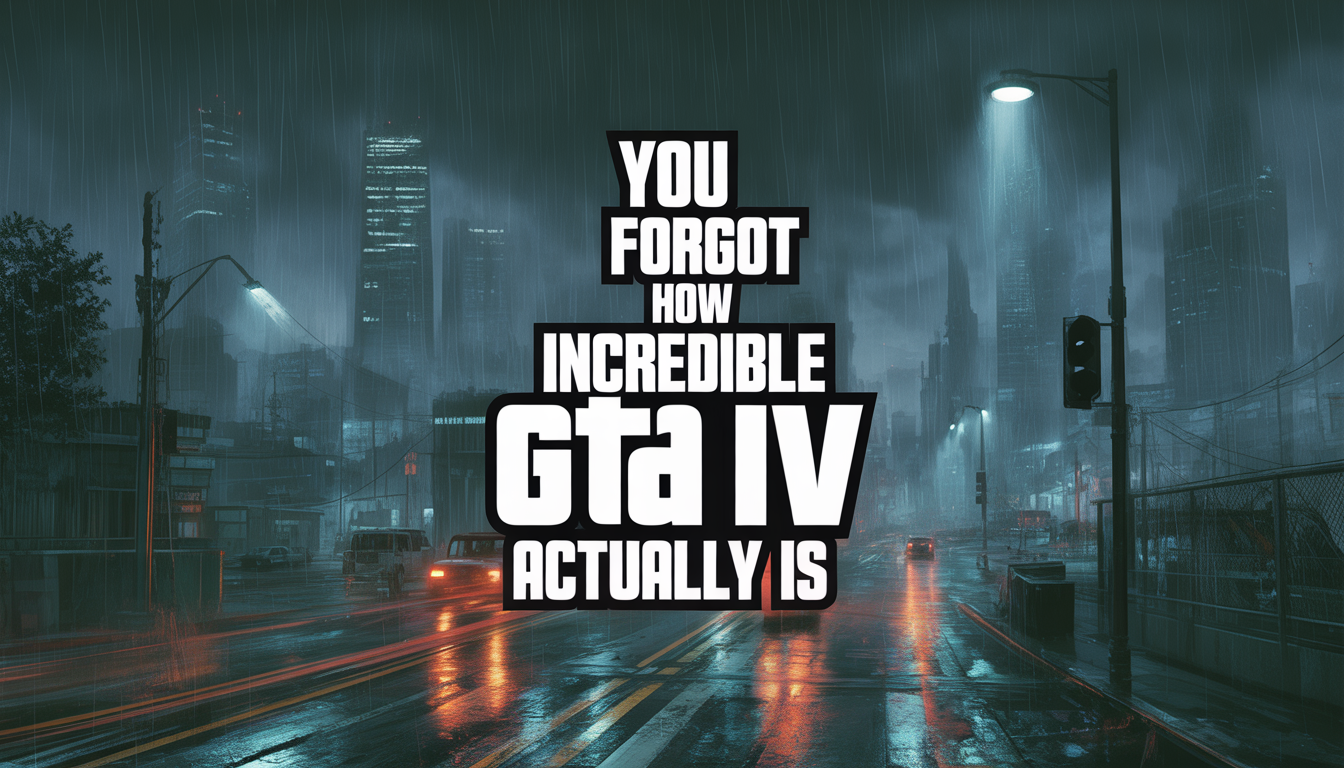
Most people remember it as just another old game. Boring driving, colorless art, and dated textures. But look closer and do a little comparison. You’d realize no modern title with five times the budget and 10 times the power will ever outperform this 17-year-old masterpiece. You might think that’s impossible, but let’s see if you still feel that way when I’m done here.
The Unmatched Physics of Everyday Chaos:
Did you know that as you bump into someone, they drop their coffee? Then you can pick it up and throw it back to them and bounce. In fact, you might see a brick on the ground and wonder if you can do anything with it. And it turns out you can. Will you come back the hell back? And this is the current state of a AAA game released only five months ago. This is where GTA 4 flexes harder than any modern open-world game with a budget the size of a Marvel movie. It’s the kind of attention to detail that makes you realize just how much Rockstar cared back then.
Try stealing someone’s car. If you hit the gas while they’re still holding the door, this happens. And check this out. This might be my favorite detail in this game. You sure are familiar with honking around ladies in GTA games. Now, guess what happens when you use Well, not the best vehicles for this job. Niko tells this to girls, “I think this car might be a bit small.” “Damn, this ain’t the right car for that.” “This car is too small for that. As flexible as you are, lady, we can’t do that in here.”
Shoot at a car’s open door, and the impact from your bullet will slam it shut. In fact, where you shoot matters as well. That’s not scripted. That’s physics. Real-time reaction to force. Even weapons follow the same logic. Fire at a gun someone’s holding, and you can literally knock it out of their hand. Sometimes it even goes off when it hits the ground with a real bullet, as it can actually hit something.
That’s GTA 4 in a nutshell. And can you believe people are playing Fortnite instead of this? If you ever fly a helicopter too close to a building, the blades start clipping the wall, sparks fly, and before long, the fans snap right off, sending you spinning helplessly toward the pavement. They didn’t need to code that, but they did.
Even Nico’s phone calls were ahead of their time. Try calling a character while they’re already hanging out with you. Instead of facing a bug or an error like most modern games, this is what happens.
And if you find someone at an ATM, wait for them to withdraw cash, then take them out. They’ll drop a lot more money compared to taking them out before the ATM interaction. It’s grim, but it’s also another layer of reactive logic that makes a 17-year-old game feel more alive than the ones releasing today.
Even small audio quirks show Rockstar’s obsession. When you drive in third person, the car’s engine sound is subtle, almost distant. But move the camera toward the front bumper and suddenly the sound gets louder, like you’re right next to the hood. It’s tiny, but it’s the kind of subtle touch that when I realized I was glad that I don’t have a taste in battle royale anymore. Every little thing, every reaction, every physics quirk was handcrafted.
Driving & Combat: The Weight of Realism:
Now, here’s where GTA 4 truly shines. The driving wasn’t fun in the arcade sense. It was realistic. Cars had weight. You couldn’t just whip around corners at full speed without thinking. Every turn mattered. I understand how realism can cost part of the fun, but I still can’t get why people hated this game’s driving so much. I mean, when you try to fly with your car and see the positive camber of the tires, how can you possibly not adore the art? The car crashes were insane, too. Like, sometimes I just hit other cars to watch mine flip in the most realistic physical way.
The same goes for combat. Shooting wasn’t smooth, but it felt real. It didn’t matter where you shot; the NPCs reacted accordingly. The physics engine, Euphoria, was insane for its time. Every punch, every fall, and every stumble looked unique. It made even small fights feel unpredictable.
A Story of Pain, Not Glory:
Before we get into the story, if you’re enjoying reading this article, go ahead and hit that like, subscribe, and comment down.
Let’s be honest, this game’s story hits harder than any other game in the series. Nico wasn’t chasing fame, women, or money. He was chasing peace, something he never really found. And that’s what made his story powerful. Every choice, every betrayal, every loss, it all felt personal. The game never treated Nico like a hero. He was a man haunted by his past, scarred by war, surrounded by liars and killers. When he killed, you could feel it. When he got betrayed, you understood it. When he explains to Ilena why he doesn’t believe in soul, that wasn’t just dialogue. That was pain, regret, and disgust wrapped in one broken voice. “And you don’t worry about your soul.” Niko replied, “After you walk into a village, and you see 50 children, all sitting neatly in a row against the church wall, each with their throats cut and their hands chopped off. You realize that the creature that could do this doesn’t have a soul.
Compare that to GTA 5, where everyone’s just a meme. Franklin’s just vibing. Trevor’s insane. Michael’s depressed. Fun character, sure, but no depth like Nico’s. In GTA 4, when a mission ended, you didn’t fist pump your crew. You just sat there, realizing what you just did. And the ending, it still hurts. Rockstar made sure you walked away hollow, not satisfied, but haunted. Because that’s the point in Liberty City. No one really wins.
Liberty City: A Living, Breathing Organism:
Liberty City wasn’t just a map. It was a living, breathing organism. It had a mood. You could practically smell the gasoline and hot dogs. Pedestrians weren’t just filler. They’d cuss you out, freak out if you pulled a gun, and even wear warm clothes when it’s raining. The cops didn’t mess around either. They’d chase you like they actually cared about Law and Order. And if you visit a hospital, which by the way is the only GTA that actually lets you do that, you’ll notice people aren’t just sitting upright like mannequins. They’re sick. Some cough, some lie back, and some move weakly like they’re really in pain.
No matter what you did in Liberty City, you would see the realistic consequences. Just get close to someone and see them put their hands on your car to be cautious. Every street corner had its own vibe. The broker felt poor and gritty. Algangquin buzzed with fake businessmen, and Bohan felt straight up cursed. You could drive for 10 minutes and feel like you just crossed social classes, and that radio man. It made you feel the city’s mood. Tired, chaotic, cynical, but still alive. It was also scary accurate with the events of the city, which added even more realism to the game.
You never have to worry about your children being exposed to profanity, nudity, pornography, drug or alcohol use, moving, heavy petting, teaagging, drier air moving in later, but right now it feels like you’re swimming in a bed bowl. Oh boy, just soupy with fog right now.
Combat’s Ugly, Unnerving Consequences:
In most modern games, combat feels like choreography. Every animation has patterns. Every reload looks like an action movie clip. But this game’s violence wasn’t pretty. It was ugly. When Nico threw a punch, it wasn’t a fancy combo. It looked brutal. The sound of a fist hitting bone wasn’t satisfying. It was unnerving. It reminded you that violence has consequences. It ripped you from reality and made you believe the guy you’re just hitting is a real person.
Shootouts in GTA 4 weren’t fun little sandboxes. They were messy, unpredictable brawls. Enemies didn’t die like paper targets. They stumbled, screamed, and crawled behind cars. Sometimes they’d even beg for life. You’d finish a fight and find shell casings scattered everywhere, cars burning, sirens echoing in the distance. It felt like you just survived a small war.
Atmosphere of Isolation & Grim Truth:
GTA 4’s biggest flex wasn’t graphics. It was a tone. Everything about Liberty City screamed isolation. The gray filter, the fog, the cracked sidewalks, even the lighting was depressing in the best possible way. Rockstar made a game that wasn’t about feeling powerful. It was about feeling trapped. You weren’t the king of the city. You were one more soul trying to claw your way up. The city didn’t care about you. It used you. This game was about reality, about the truth. And the truth is this. A gray town with gray people doing things they don’t like. A town full of horrible actions and darkness. When we talk about realism, it’s not just about the physics or graphics. It’s about the tone. But apparently, people didn’t want that. It turns out people who embrace reality aren’t as many as those who run from it. They say you play video games to escape reality. I say you don’t need to. If you build yourself a good one.
Humor in the Grit: Perfectly Balanced Satire:
And yet, for a game so heavy, GTA 4 still had Rockstar’s signature humor baked in. Here, read this to one of the radio ads. “Michael Graves changes his mind more often than he changes his underwear, which is strange for a man rumored to be incontinent. Tell Michael Graves to get his hand out of your pocket and off your children’s ass. Vote John Hunter for governor.” Nothing felt out of place. And in another scene in the game involving Niko, “Hey. Uh, hello. I’m busy. I said hello.” He kicked the man, hahaha.
Nico wasn’t a comedian, but he tried every once in a while. In another scene, Niko tried his humor. “FattyRoman cousin. What’s your name again? Big mouth prick. Very Catchy, sit down. That’s it. Nico, not big mouth prick. You funny guy. I try.” It balanced the grit perfectly. The game was depressing. Yeah, but never lifeless.
DLCs: Expanding the World Through Story:
Don’t forget the Lost and Damned and the Ballad of Gay Tony. Rockstar didn’t just give us more missions; they gave us new perspectives. Johnny Kvitz’s story was about loyalty and decay, showing the biker underworld falling apart from the inside, while Luis Lopez’s story injected that stylish high-life energy that contrasted beautifully with Nico’s grit. Those DLCs made Liberty City feel bigger without expanding the map because it wasn’t about size. It was about stories. Every block, every alley, every bar had another layer.
And when all three stories intertwined, it felt like watching a TV series where every episode hit differently. Compare that to how Rockstar does DLC’s now, or should I say doesn’t. GTA 4’s expansions were built from love for storytelling, not cash grabs.
Conclusion:
GTA 4 isn’t the most polished game. It’s gray, slow, and sometimes just mean. But that’s what makes it legendary. It’s not a game that flatters you. It humbles you. It showed us a version of Rockstar that cared more about art than algorithms. About storytelling, not shark cards. About emotion, not explosions. So yeah, maybe the cars weren’t exciting to drive. Maybe the lighting was bleak. Maybe Roman called way too much. But damn if that didn’t make Liberty City feel real. And it’s about time we realize what we play today aren’t games.
FAQs:
1. Why is GTA IV’s physics system considered special?
Because it creates unscripted, reactive chaos from everyday interactions.
2. How does GTA IV’s driving differ from other games?
It prioritizes realistic vehicle weight and consequences over arcade-style fun.
3. What makes Niko Bellic’s story unique in the GTA series?
It’s a tragic pursuit of peace, not fame or fortune, full of personal pain.
4. How does Liberty City feel more alive than other game worlds?
Through reactive pedestrians, systemic details, and distinct, mood-driven districts.
5. Why is the combat in GTA IV described as “ugly”?
It emphasizes brutal, consequential violence over stylish, choreographed action.
6. What did the DLCs add to the GTA IV experience?
They expanded the world with new, contrasting stories, not just more missions.